
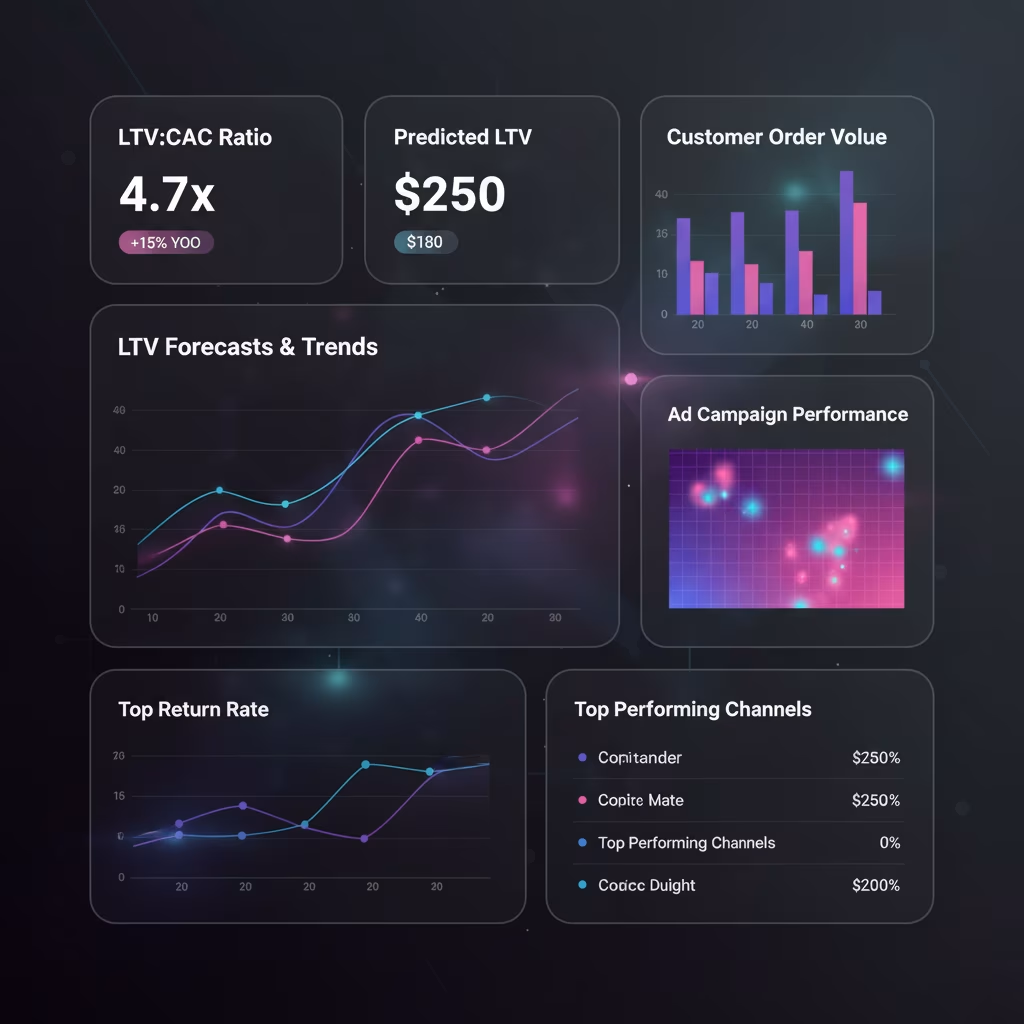
Most e-commerce brands are leaving money on the table. They optimize for ROAS, chase short-term conversions, and wonder why growth stalls at scale. The problem? They're optimizing for the wrong metric. Predictive modeling shifts your focus from immediate returns to long-term customer value, enabling you to identify high-value customers early, allocate budget strategically, and build a sustainable growth engine that scales profitably.
This comprehensive guide walks you through the exact process of implementing predictive LTV modeling in your e-commerce business. You'll learn how to build forecasting models, integrate them into your advertising strategy, and make data-driven decisions that maximize customer lifetime value while maintaining healthy unit economics.
Table of Contents
- 1Prerequisites & Requirements
- 2Understanding Predictive LTV Modeling
- 3Step-by-Step Implementation Guide
- 4Step 1: Data Collection & Preparation
- 5Step 2: Building Your Predictive Model
- 6Step 3: Integrating LTV Predictions into Ad Platforms
- 7Step 4: Testing & Optimization
- 8Troubleshooting Common Issues
- 9Best Practices & Pro Tips
- 10Measuring Success: Key Performance Indicators
Prerequisites & Requirements
Before diving into predictive LTV modeling, ensure you have the necessary foundation in place. This isn't a beginner-level tactic—it requires specific data infrastructure and business maturity to execute effectively.
Historical Customer Data
At least 6-12 months of customer purchase history with timestamps, order values, and customer identifiers. Minimum 1,000 completed customer journeys for statistical significance.
Analytics Infrastructure
Functioning analytics platform (Google Analytics 4, Segment, or similar) tracking customer behavior across touchpoints. Clean attribution data connecting ad interactions to purchases.
Technical Resources
Access to data science tools (Python/R) or business intelligence platforms with predictive capabilities. API access to your ad platforms for value-based bidding implementation.
Cross-Functional Alignment
Buy-in from marketing, finance, and product teams. Clear understanding of target LTV:CAC ratios and acceptable payback periods for your business model.
Data Quality is Critical
Predictive models are only as good as the data they're trained on. If your historical data has gaps, inconsistent customer identifiers, or poor attribution tracking, invest time in cleaning and validating your data before building models. Garbage in equals garbage out.
Understanding Predictive LTV Modeling
Predictive LTV modeling uses historical customer behavior patterns to forecast future value. Unlike traditional LTV calculations that look backward, predictive models analyze purchase frequency, average order value, retention rates, and behavioral signals to estimate what a customer will spend over their entire relationship with your brand.
The power of this approach lies in early identification. By predicting LTV after just one or two purchases, you can dramatically shift your acquisition and retention strategies, investing more aggressively in high-value segments while reducing waste on low-value cohorts.
Step-by-Step Implementation Guide
Follow this proven framework to build and deploy predictive LTV models that drive profitable growth. Each step builds on the previous one, so resist the temptation to skip ahead.
Step 1: Data Collection & Preparation
Extract Customer Transaction Data
Pull complete purchase history from your e-commerce platform including customer ID, order date, order value, product categories, discount codes used, and payment method. Export data covering at least the past 12-18 months for robust pattern recognition.
Gather Behavioral Signals
Collect engagement metrics from your analytics platform: website visits, time on site, pages viewed, email open rates, cart abandonment events, and product browsing patterns. These behavioral indicators are often more predictive than transaction data alone.
Enrich with Customer Attributes
Add demographic and firmographic data where available: acquisition channel, geographic location, device type, referral source, and any survey or profile information. More context improves prediction accuracy.
Create Calculated Features
Engineer key variables that capture customer behavior patterns: days between first and second purchase (velocity metric), average order value trend, category affinity scores, discount sensitivity index, and engagement decay rate. These derived features often have the highest predictive power.
Clean and Validate Data
Remove duplicate records, handle missing values, identify and address outliers (like test orders or fraudulent transactions), and ensure consistent customer identifiers across all data sources. Run validation checks to confirm data integrity before modeling.
Data Privacy Compliance
Ensure your data collection and usage complies with GDPR, CCPA, and other relevant privacy regulations. Implement proper consent mechanisms, data anonymization where appropriate, and clear retention policies. Consult with legal counsel if uncertain about compliance requirements.
Step 2: Building Your Predictive Model
With clean data in hand, you're ready to build the predictive engine. You have several modeling approaches to choose from, each with tradeoffs between accuracy, interpretability, and implementation complexity.
Choose Your Modeling Approach
Select between cohort-based models (group customers by acquisition date and extrapolate patterns), RFM-based predictions (recency, frequency, monetary scoring), or machine learning models (regression, random forests, gradient boosting). For most e-commerce brands, gradient boosting models offer the best balance of accuracy and explainability.
Split Data into Training and Validation Sets
Divide your historical data into training (70-80%) and validation (20-30%) sets. Use time-based splitting rather than random sampling—train on older data, validate on recent data to simulate real-world prediction scenarios. This prevents data leakage and provides realistic performance estimates.
Train Your Initial Model
Feed your training data into your chosen algorithm. For machine learning approaches, start with default hyperparameters and focus on feature selection first. Your goal is predicting total revenue a customer will generate over the next 12-24 months based on early behavior signals.
Evaluate Model Performance
Test predictions against your validation set using metrics like Mean Absolute Error (MAE), Root Mean Squared Error (RMSE), and R-squared. For business context, compare predicted LTV segments to actual revenue—can your model accurately identify high-value customers early?
Iterate and Refine
Experiment with different features, try ensemble methods combining multiple models, and tune hyperparameters to improve accuracy. Pay special attention to prediction calibration—ensure your model doesn't consistently over or under-predict value across different customer segments.
Establish Prediction Confidence Intervals
Calculate confidence ranges for your predictions (e.g., 80% confidence this customer will spend between $450-$650). These ranges inform how aggressively you should bid—narrow ranges justify aggressive spend, wide ranges suggest caution.
Step 3: Integrating LTV Predictions into Ad Platforms
Your predictive model is worthless unless it influences real advertising decisions. This step connects your LTV forecasts to platform bidding algorithms, enabling true value-based optimization.
Set Up Conversion Value Passing
Configure your tracking pixels to pass predicted LTV values instead of (or in addition to) transaction values. For Meta, use the value parameter in your conversion events. For Google, implement conversion value rules or enhanced conversions. This tells platforms the true value of each conversion.
Create Value-Based Bid Strategies
Switch from Target ROAS to Target ROAS with predicted values, or implement Value-based Bidding strategies available in Google and Meta. These strategies automatically adjust bids based on the predicted value you're passing, not just the immediate conversion value.
Build High-Value Lookalike Audiences
Upload your top predicted LTV customers as seed audiences for lookalike expansion. Platforms can find users similar to your most valuable customers, dramatically improving acquisition quality. Refresh these audiences monthly as predictions update.
Implement Segmented Campaign Structure
Create separate campaigns for high, medium, and low predicted LTV segments. Allocate budget proportionally—spend more aggressively on high-LTV prospects even if immediate ROAS appears lower. This long-term view is where predictive modeling creates competitive advantage.
Configure Automated Rules and Scripts
Set up automated adjustments that increase bids for high-LTV audiences during peak conversion windows, pause spend on consistently low-value segments, and reallocate budget toward campaigns attracting high-predicted-value customers.
Step 4: Testing & Optimization
Implementation is just the beginning. Continuous testing and refinement ensure your predictive LTV strategy delivers maximum profit impact over time.
Run Controlled A/B Tests
Split your ad account or use geographic holdout groups to compare LTV-based optimization against your previous approach. Run tests for at least 60-90 days to account for longer purchase cycles and ensure statistical significance. Track both short-term ROAS and long-term customer value.
Monitor Prediction Drift
Track how your model's predictions compare to actual customer behavior over time. Calculate the difference between predicted and realized LTV monthly. Significant drift (>15% error) signals the need for model retraining with fresh data.
Analyze Segment Performance
Break down results by predicted LTV segment, acquisition channel, product category, and time period. Identify which segments and channels deliver the best LTV:CAC ratios. Double down on winners, cut or fix underperformers.
Retrain Models Quarterly
Incorporate new customer data every 90 days to keep predictions accurate as your business evolves. Seasonal patterns, product mix changes, and market conditions all impact customer behavior—your model must adapt to remain effective.
Expand to Retention Campaigns
Use LTV predictions to trigger retention interventions. Send win-back campaigns to high-predicted-value customers who haven't purchased recently. Offer VIP experiences to customers predicted to have long-term value. This closes the loop between acquisition and retention.
Troubleshooting Common Issues
Even with careful implementation, you'll encounter challenges. Here's how to diagnose and resolve the most common problems that arise when deploying predictive LTV models.
Symptoms: Predicted LTV values are consistently 2-3x higher or lower than actual customer value after sufficient time has passed. Root Causes: Insufficient training data, poor feature selection, data quality issues, or model overfitting to historical patterns that no longer apply. Solutions: Audit your training data for quality issues. Verify you have enough historical customer journeys (minimum 1,000). Remove outliers that skew predictions. Try simpler modeling approaches—sometimes a well-calibrated cohort model outperforms a complex ML model with insufficient data. Consider implementing ensemble methods that average predictions from multiple approaches.
Symptoms: You're passing predicted LTV values but campaign performance hasn't changed, or platform reporting shows they're still optimizing for transaction value. Root Causes: Incorrect pixel implementation, values aren't being passed in the correct format, or insufficient learning phase data for value-based optimization. Solutions: Use platform debugging tools to verify values are being received correctly. Check that conversion events include the value parameter. Ensure you're passing values consistently across all conversion events. Allow 2-4 weeks of learning phase before expecting optimization changes. Some platforms require minimum conversion volumes before value-based bidding activates.
Symptoms: Immediate return on ad spend dropped when switching to LTV-based optimization, causing alarm from stakeholders. Root Causes: This is often expected behavior—you're now investing more in high-lifetime-value customers who may have lower immediate conversion rates but generate significantly more profit over time. Solutions: Set expectations upfront that short-term ROAS may decline while long-term profitability improves. Track cohort-based metrics showing customer value over 30, 60, 90+ days. Calculate blended CAC payback periods. If decrease exceeds 30% or persists beyond learning phase, audit your LTV predictions for accuracy and consider adjusting bidding aggressiveness.
Pro Tip: Build Executive Dashboards
Create executive-level reporting that shows LTV:CAC ratio trends, cohort profitability curves, and customer payback periods alongside traditional ROAS metrics. This dual view helps stakeholders understand the strategic shift and maintains confidence during transition periods.
Best Practices & Pro Tips
Beyond the core implementation steps, these advanced tactics separate good predictive LTV programs from exceptional ones that drive sustainable competitive advantage.
Layer Multiple Data Sources
Don't rely solely on transactional data. Incorporate email engagement metrics, customer service interactions, social media sentiment, and product review activity. These signals often predict churn or expansion before purchase behavior changes become evident.
Implement Real-Time Scoring
Move beyond batch predictions to real-time LTV scoring that updates as customers interact with your brand. This enables dynamic bid adjustments and personalized experiences based on the most current behavioral signals, maximizing relevance and conversion probability.
Test Prediction Timeframes
Experiment with different LTV prediction windows—12 months, 24 months, or lifetime. Shorter windows often prove more accurate and actionable for fast-moving consumer brands, while longer windows suit high-ticket or subscription businesses. Find the optimal horizon for your model.
Create Feedback Loops
Feed actual customer outcomes back into your model continuously. Implement automated pipelines that retrain models when prediction error exceeds thresholds. This ensures your system adapts to changing customer behavior patterns without manual intervention.
Build Prediction Guardrails
Set maximum bid multipliers and budget caps based on prediction confidence levels. Don't allow the system to spend unlimited amounts on uncertain predictions. Require higher confidence scores for more aggressive bidding, protecting against model errors while capitalizing on high-confidence opportunities.
Conduct Regular Model Audits
Quarterly, examine which features drive predictions, verify the model isn't relying on spurious correlations, and test for bias across customer segments. Ensure predictions remain fair and don't inadvertently exclude valuable customer groups based on demographic characteristics.
Measuring Success: Key Performance Indicators
Success with predictive LTV modeling isn't measured by traditional metrics alone. Track these KPIs to assess true program impact and justify continued investment in sophisticated modeling approaches.
| Metric | What It Measures | Target Range | Measurement Frequency |
|---|---|---|---|
| LTV:CAC Ratio | Revenue generated per dollar spent acquiring customers | 3:1 to 5:1 | Monthly by cohort |
| Prediction Accuracy | How closely predicted LTV matches actual customer value | >80% within ±20% | Quarterly |
| CAC Payback Period | Months required to recover customer acquisition cost | <6 months | Monthly by channel |
| Cohort Revenue Curves | Revenue trajectory of customer groups over time | Upward trend | Monthly |
| Model Calibration Error | Systematic over or under-prediction across segments | <10% deviation | Monthly |
| High-Value Customer % | Percentage of acquisitions in top LTV quartile | Increasing trend | Weekly |
Beyond quantitative metrics, assess qualitative factors: Has your marketing team shifted from short-term conversion hunting to strategic customer acquisition? Are budget allocation discussions focused on long-term value rather than immediate returns? Is there cross-functional alignment around customer lifetime economics? These organizational shifts often deliver more lasting value than the models themselves.
Key Takeaways
- Predictive LTV modeling requires 6-12 months of quality customer data and proper analytics infrastructure before implementation
- Value-based bidding strategies using predicted LTV can improve ROAS by 120-340% compared to traditional conversion optimization
- Expect short-term ROAS to potentially decrease as you invest more in high-lifetime-value customers with longer conversion cycles
- Model accuracy above 80% is achievable with proper feature engineering and continuous retraining every 90 days
- The organizational shift toward long-term customer value thinking often delivers more impact than the technical models themselves