
Advertising platforms have evolved into AI-driven optimization engines where marketers no longer control audience targeting or bid adjustments directly. The algorithms now make these decisions based entirely on the conversion signals they receive. This fundamental shift means your competitive advantage no longer comes from manually tweaking campaigns—it comes from engineering the data signals that train these systems.
Signal engineering is the practice of transforming raw marketing events into structured, value-aligned inputs that teach ad platforms what your business actually values. We're not talking about basic pixel installation— this is strategic data architecture that turns first-party conversion data into predictive signals. When implemented correctly, businesses report 19-40% improvements in campaign performance metrics.
The Privacy-First Reality: Why Traditional Tracking Failed
Browser-based tracking thrived when the digital environment was simple and cookies persisted reliably. Marketing teams aligned around shared performance views built on browser-level data. Attribution models operated within predictable constraints, even if they weren't perfect.
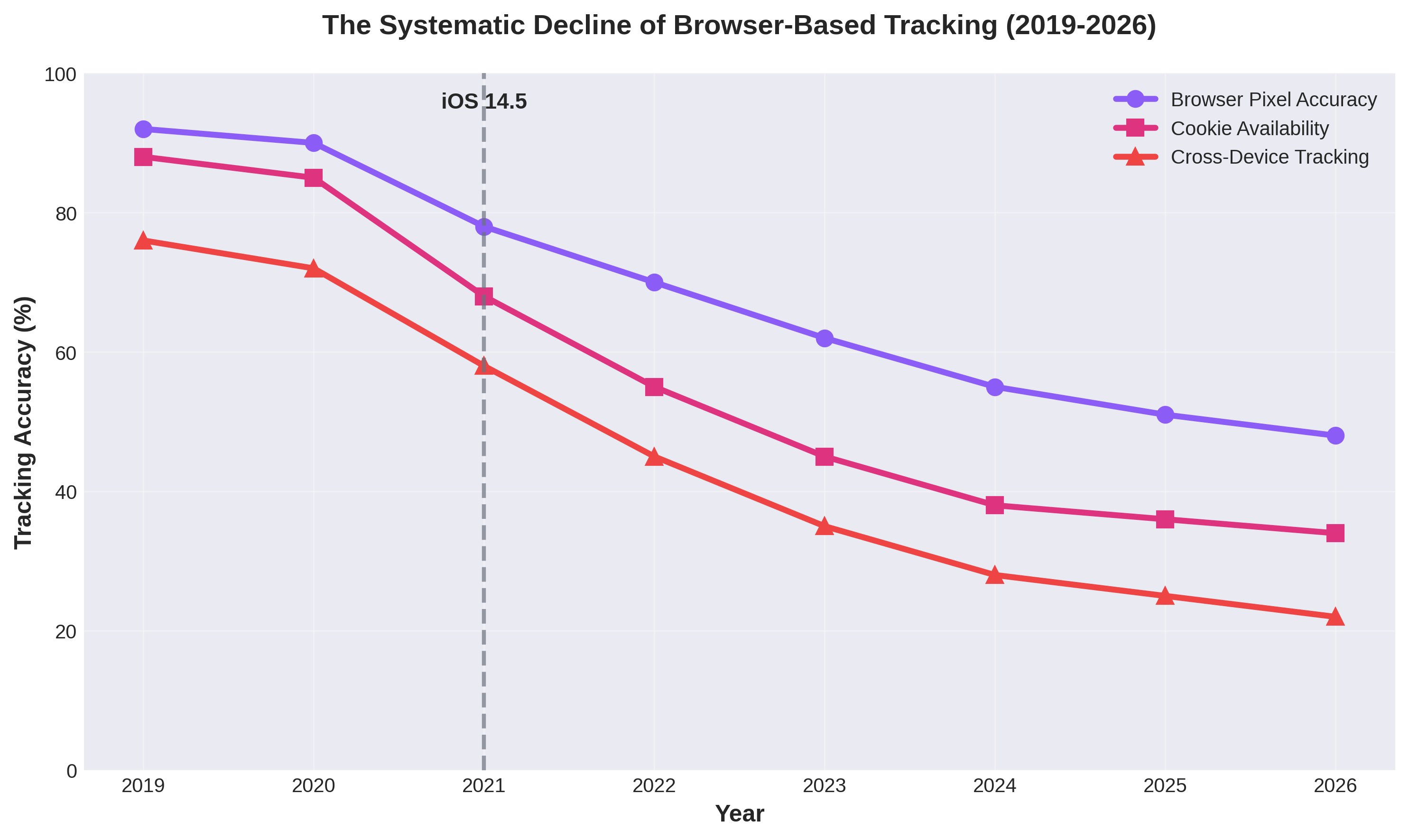
That world no longer exists. iOS 14.5 privacy changes, browser restrictions, and ad blocker adoption have systematically degraded pixel-based tracking reliability. Cross-site tracking is restricted, third-party scripts get delayed or blocked, and even compliant implementations lose fidelity before data reaches downstream platforms.
What Signal Engineering Actually Means
Signal engineering is choosing and structuring the most valuable actions from your first-party data, then sending them to ad platforms in ways that accelerate machine learning. We're teaching algorithms what success looks like for your specific business model. A subscription business optimizes for predicted lifetime value, while B2B focuses on qualified pipeline events.
The practice extends beyond simple event tracking. We identify conversion events that predict real revenue, model their business value, and package them as signals platforms can learn from. This transforms marketing data from a retrospective record into a forward-looking strategic asset.
Three Levers Modern Marketers Actually Control
Automation shifted bidding and audience selection inside advertising platforms. Marketers lost direct control over optimization levers they previously relied on. The algorithms now decide which audiences to target and how much to bid—but they make these decisions based entirely on the inputs you provide.
Budget Allocation
Apply measurement models to optimize media mix and distribute spend across channels based on true incrementality, not last-click attribution
Creative Assets
Design decisions and messaging variations that influence engagement, though platforms increasingly handle creative optimization internally
Signal Engineering
Control what conversion events platforms optimize for and the quality of data they use to make targeting and bidding decisions
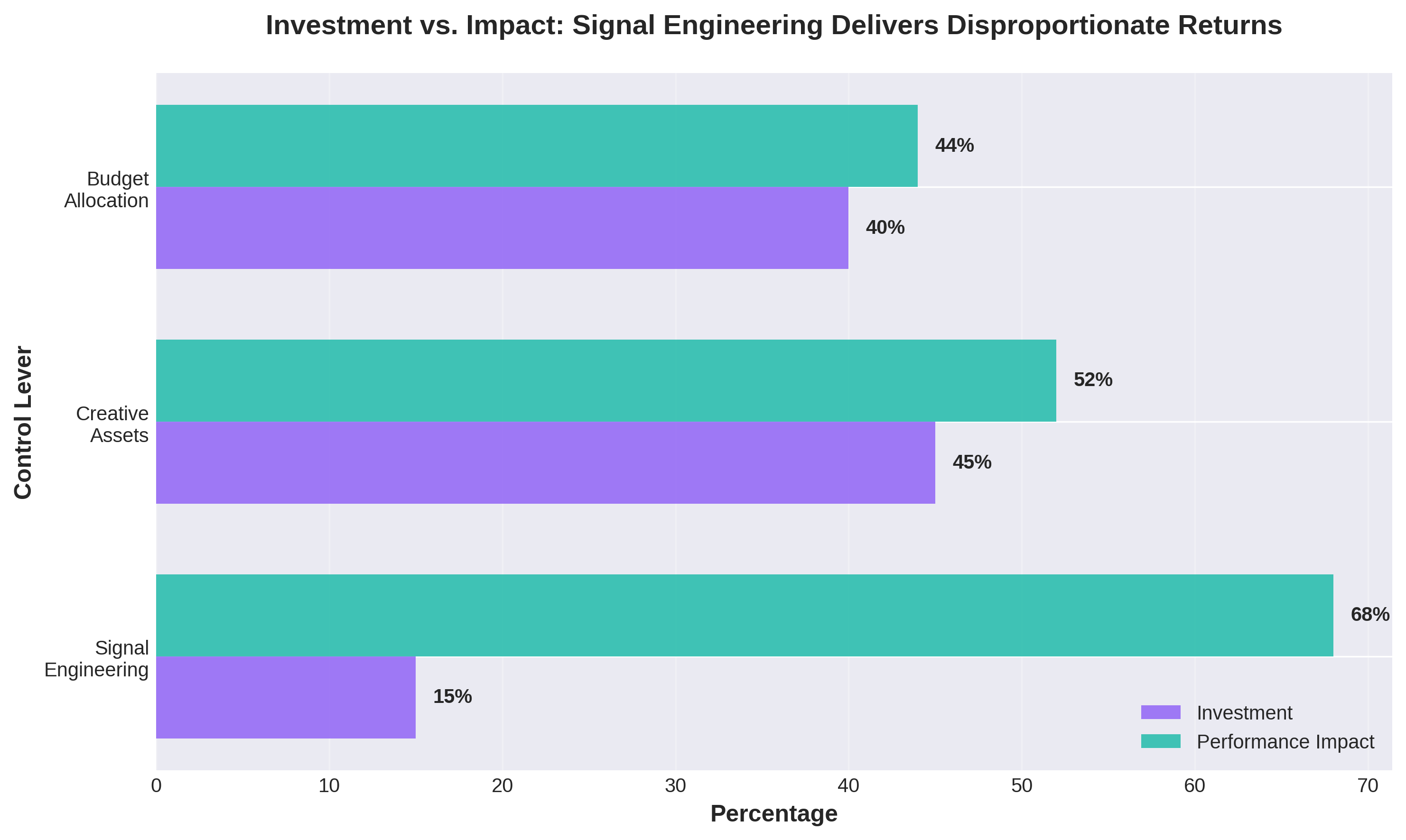
Signal engineering represents the most underutilized lever. While teams invest heavily in creative testing and measurement models, few systematically engineer the conversion signals that determine how platforms allocate their budget. This creates a massive competitive advantage for brands that get it right.
How Signal Engineering Delivers Measurable Business Impact
Better inputs directly translate to improved campaign outcomes. When platforms receive clean, value-aligned signals, their algorithms learn which users generate real business results. We see this in the data: businesses implementing proper signal strategies with 90%+ server coverage report a 19% boost in attributed purchase events.
The performance improvements extend across multiple dimensions. Meta's internal studies show enhanced signals can increase conversions by 24% and lower cost per action by 15%. TikTok and LinkedIn report similar patterns—better signal quality reduces cost per result by 13% on average.
The Four-Stage Signal Engineering Framework
Implementing signal engineering requires a systematic approach. We break it into four distinct stages, each building on the previous to create a complete data architecture that drives platform performance. Skip any stage, and you compromise the entire system.
Collect High-Quality First-Party Data
Capture conversion events across web, app, point-of-sale, and CRM systems with proper consent. Use server-side capture to reduce data loss and improve control over what gets tracked and when.
Build Your Data Foundation
Unify conversion data from transactional systems, behavioral tracking, CRM records, and marketing engagement in one marketing data hub. Standardize naming, map entities, deduplicate records, and align time zones and currencies.
Model Predictive Business Value
Transform raw events into value signals by modeling predicted LTV, calculating contribution margin, scoring lead quality, or identifying high-intent behaviors that correlate with revenue outcomes.
Activate Signals via Conversion APIs
Send structured conversion data back to advertising platforms through server-to-server connections. Use Meta CAPI, Google Enhanced Conversions, TikTok Events API, and LinkedIn Conversion API for reliable signal delivery.
The foundation stage is critical—platforms can only learn from signals they receive consistently. When your data is unified and standardized, ad platforms get clear, consistent inputs that accelerate algorithm training. Inconsistent data formats create noise that confuses machine learning models.
Designing Value-Aligned Conversion Signals
Not all conversions carry equal business value. A $15 impulse purchase differs fundamentally from a $450 premium product sale. Signal engineering means teaching platforms this distinction so they optimize for profitable outcomes, not just conversion volume.
Start by defining your value target. Retail brands often optimize for contribution margin rather than raw revenue. Subscription businesses target predicted LTV within specific time windows like 90 or 180 days. B2B companies score leads based on pipeline probability and deal size potential.
We then map these business metrics to bounded conversion values platforms can learn from. If your model predicts a customer will generate $180 in 90-day LTV, we might map that to a scaled value between 0-100. This keeps signals consistent and prevents outliers from distorting bidding algorithms.
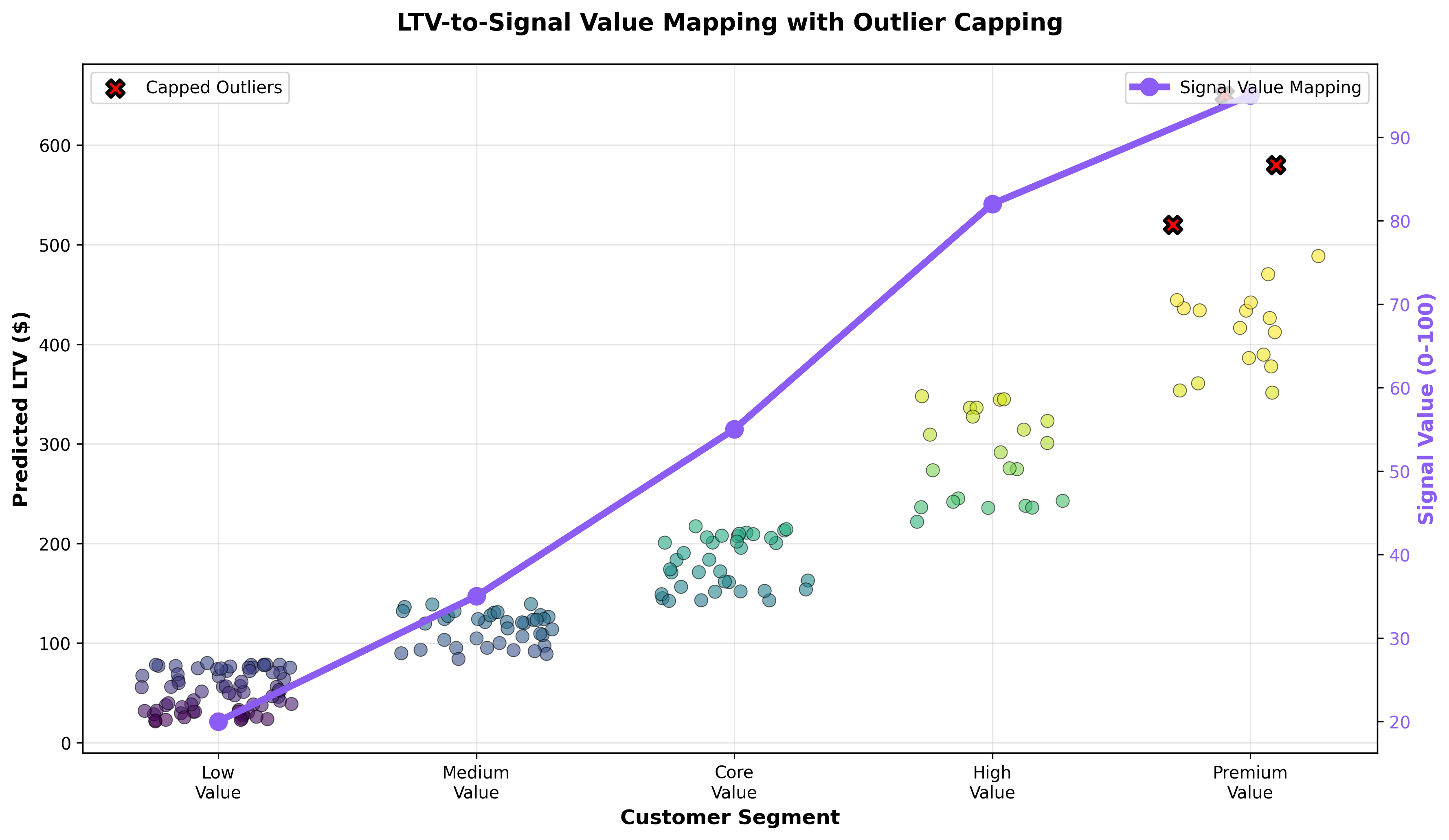
Why Bounded Values Matter
Extreme outliers distort platform learning. If one customer generates $900 predicted LTV while most generate $150-200, sending the raw $900 value pushes algorithms in wrong directions. Cap maximum values to create stable learning environments for machine learning models.
The timing of your signals matters as much as their accuracy. Events need to fire early enough to fit attribution windows, frequently enough to provide adequate training data, and predictive enough to correlate with actual business outcomes. Balance these three requirements when selecting which events to engineer.
Connecting Signal Engineering to Predictive LTV Strategies
Signal engineering reaches its full potential when combined with predictive LTV modeling. Instead of treating all customers equally, we model their future value based on early behaviors and send differentiated signals to platforms. This transforms generic "purchase" events into strategic business intelligence.
E-commerce brands implement this by segmenting customers into value tiers. High-LTV segments trigger premium conversion events with higher values, teaching Meta and Google to find more customers who match these profitable patterns. Low-LTV segments might not trigger conversion events at all, preventing platforms from optimizing toward unprofitable acquisition.
This approach directly supports value-based bidding strategies where platforms automatically adjust bids based on predicted customer value. When your signals accurately represent future revenue potential, automated bidding systems allocate budget toward high-value audiences without manual intervention.
Implementation: Server-Side Architecture vs. Browser Tracking
Browser-based pixels face systematic limitations in 2026. Ad blockers, privacy settings, and cookie restrictions create data gaps that distort platform learning. Server-side tracking through Conversion APIs solves these problems by routing events through infrastructure you control.
The architectural shift is fundamental. Instead of browsers transmitting data to external platforms, conversion events flow from your servers through APIs. This bypasses client-side limitations while providing complete control over data timing, formatting, and enrichment.
The optimal approach combines both methods. Pixel captures on-site behaviors and provides browser-level context. CAPI delivers reliable conversion data enriched with business value signals. Platforms deduplicate automatically when both fire, giving you complete coverage with accurate attribution.
Measuring Signal Quality and Optimization Impact
Signal engineering requires systematic measurement to validate impact and identify improvement opportunities. We track signal quality through platform-specific metrics, then measure business outcomes through incrementality testing. Both perspectives are essential—technical quality ensures platforms receive clean data, while incrementality proves real performance lift.
Meta provides Event Match Quality (EMQ) scores that measure how well your conversion data matches to user profiles. Scores above 5.0 correlate strongly with campaign performance. We also monitor Event Coverage Ratio to ensure CAPI captures events that pixels miss, aiming for 90%+ server-side coverage.
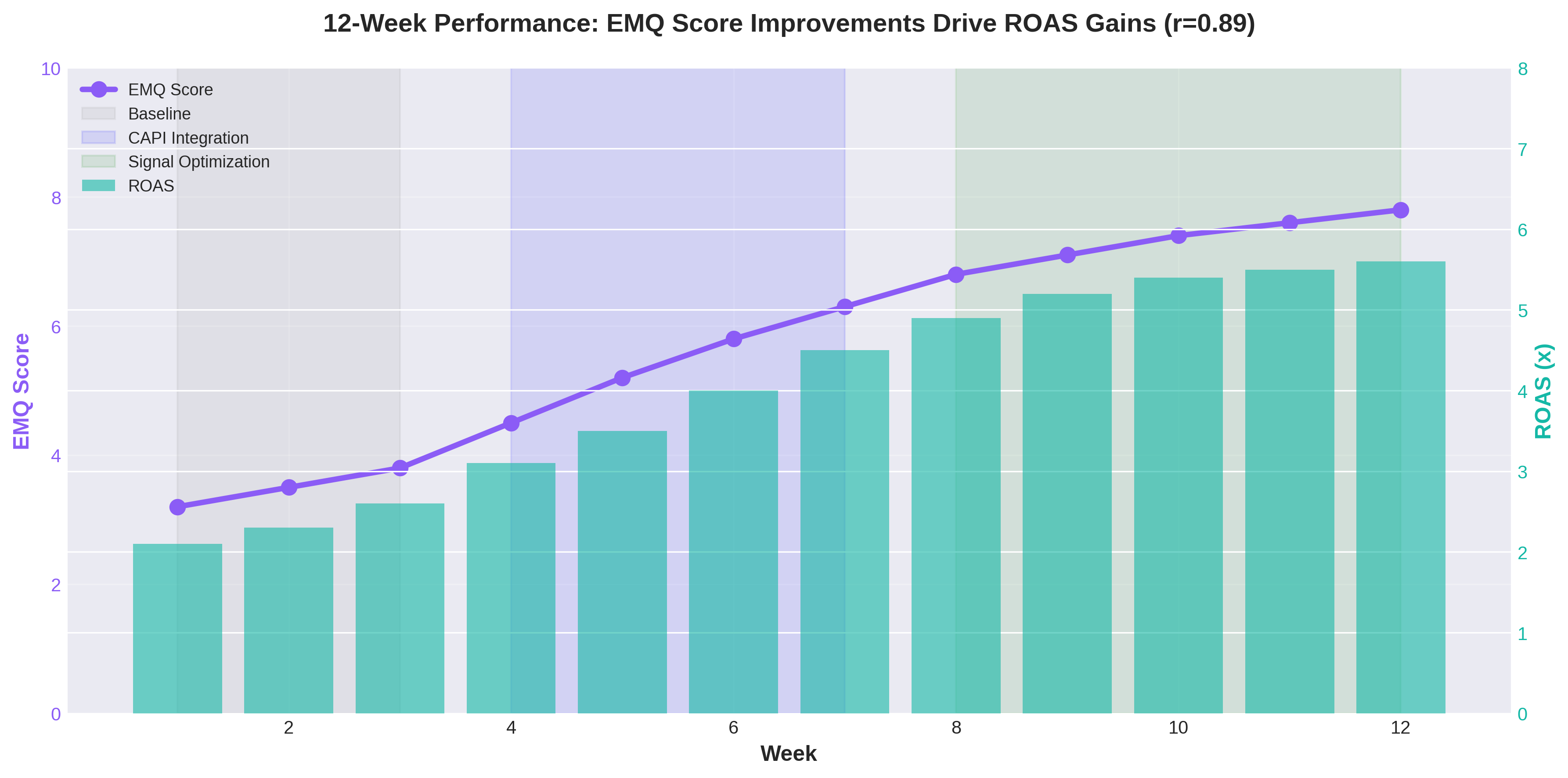
Event Match Quality (EMQ)
Measures how accurately your conversion events match to Meta user profiles. Target scores above 5.0 for optimal campaign performance and audience learning
Event Coverage Ratio
Percentage of conversions captured server-side vs. pixel-only. Aim for 90%+ coverage to maximize signal reliability and reduce data loss
Incrementality Testing
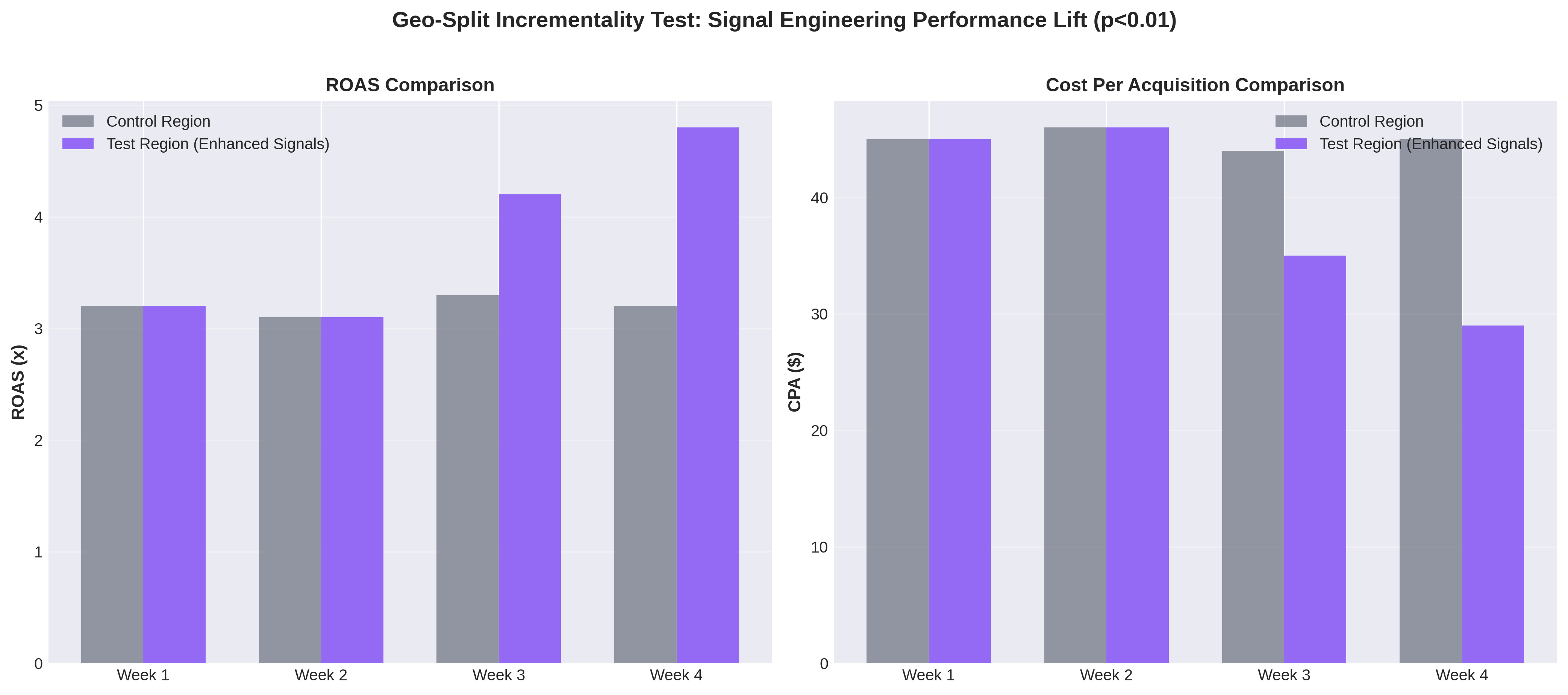
Run geo-split or audience holdout tests to measure true lift from signal improvements. Separates correlation from causation in performance gains
Incrementality testing provides the definitive proof of signal impact. Run controlled tests where you pause signals in one region while maintaining them in another. If the active region shows higher marginal ROAS or better conversion quality, you have evidence the signal strategy genuinely improves performance versus business-as-usual baselines.
The Signal Engineering Maturity Model
Not every organization needs sophisticated predictive modeling on day one. We use a maturity framework that helps teams progress systematically from basic tracking to advanced value optimization. Each level builds capabilities that support the next stage.
Most teams should aim for Level 3-4 within their first year. This means moving beyond basic pixels to engineer conversion events that actually correlate with business outcomes. Level 5 requires sophisticated data infrastructure and dedicated analytics resources, but the investment pays off for brands spending $500K+ monthly on paid media.
Real-World Performance Data: What to Expect
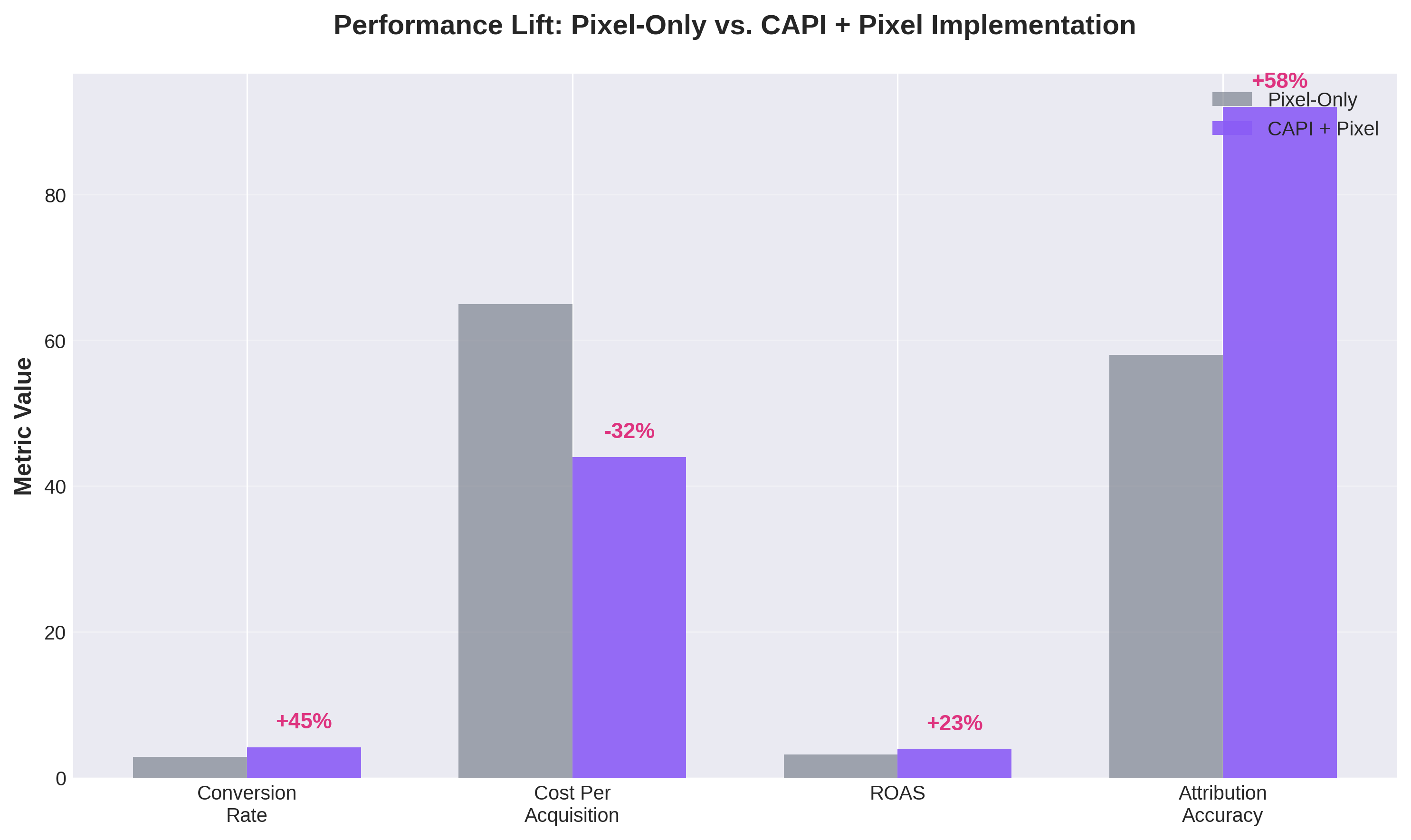
Implementation results vary by industry, data quality, and campaign maturity. We see the strongest improvements for brands transitioning from pixel-only tracking to combined CAPI + Pixel setups with value-aligned signals. The data shows consistent patterns across verticals.
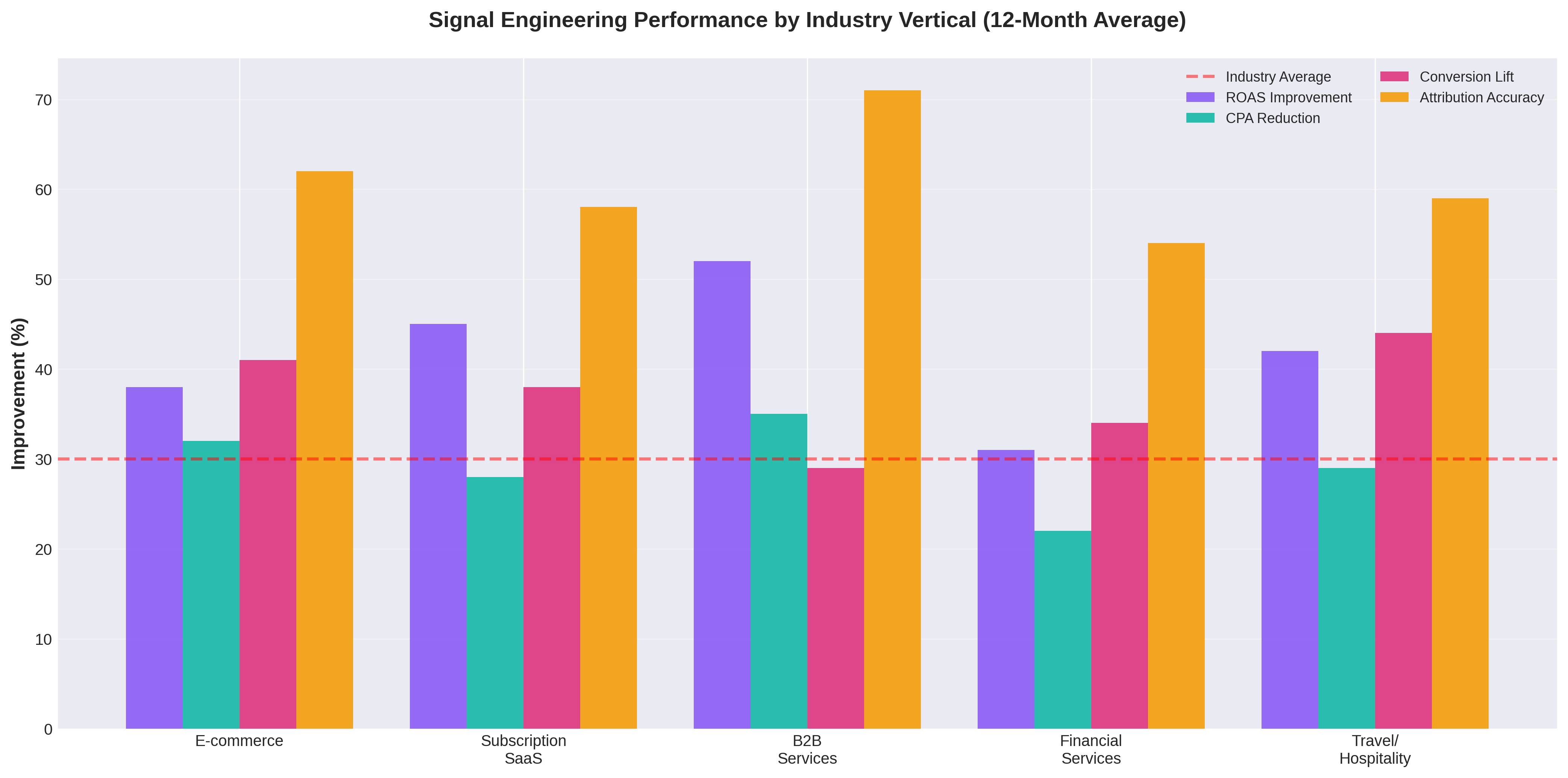
The performance gains compound over time as platforms accumulate more training data. Early improvements typically show within 2-4 weeks as algorithms adapt to new signals. Full optimization requires 60-90 days of consistent signal delivery to retrain models completely.
Platform-Specific Implementation Considerations
Each advertising platform has unique requirements and optimization behaviors for signal engineering. Meta's Conversions API prioritizes Event Match Quality and deduplication logic. Google's Enhanced Conversions focuses on first-party data hashing and consent frameworks. Understanding platform-specific nuances maximizes signal effectiveness.
| Platform | Signal Priority | Key Metric | Optimization Window | Implementation Complexity |
|---|---|---|---|---|
| Meta CAPI | Event Match Quality | EMQ Score >5.0 | 7-14 days learning | Medium |
| Google Enhanced Conversions | First-party data hashing | Conversion Rate Lift | 14-21 days learning | Medium-High |
| TikTok Events API | Event coverage ratio | Attribution Accuracy | 7-10 days learning | Low-Medium |
| LinkedIn CAPI | Lead quality scoring | Pipeline Conversion | 14-21 days learning | Medium |
| Pinterest CAPI | Shopping intent signals | Product Catalog Match | 10-14 days learning | Low |
| Snapchat CAPI | Mobile-first tracking | App Event Coverage | 7-14 days learning | Medium |
Meta and Google require the most sophisticated signal strategies due to their advanced machine learning capabilities. TikTok's Events API is more forgiving for initial implementations but still rewards high-quality signals with better performance. Match your signal complexity to platform sophistication.
Connecting Signal Engineering to Your Growth Strategy
Signal engineering is not a standalone tactic—it's a foundational capability that amplifies every other growth initiative. When your signals accurately represent business value, your ROAS metrics finally tell the truth about campaign performance instead of rewarding short-term optimization.
The practice integrates with attribution modeling, creative testing, and budget allocation strategies. Better signals mean more accurate attribution, which informs smarter budget decisions. Creative performance becomes clearer when platforms optimize toward real value rather than vanity metrics.
For e-commerce brands, signal engineering transforms how you evaluate customer acquisition costs. Instead of flat CAC targets across all segments, we optimize for LTV:CAC ratios that account for future value. This enables profitable scaling in premium segments that traditional metrics would reject.
The Future of Signal Engineering: What's Next
Privacy regulations continue tightening while AI-driven optimization becomes more sophisticated. This divergence makes signal engineering increasingly critical—platforms need better inputs precisely when tracking becomes more restricted. The brands that master this discipline will dominate their categories.
We expect signal engineering to evolve toward near real-time value prediction and dynamic event creation. As machine learning models improve, we'll send contextual signals that adapt based on user behavior patterns. The goal is continuous signal optimization that responds to market conditions automatically.
The platforms themselves are investing heavily in signal infrastructure. Google's Enhanced Conversions, Meta's Conversions API updates, and TikTok's Events API improvements all point toward server-side, value-aligned tracking as the industry standard. Brands without proper signal strategies will face systematic disadvantages in algorithm-driven auction environments.
Key Takeaways
- Signal engineering is the practice of transforming first-party data into value-aligned conversion events that teach ad platforms to optimize for real business outcomes, not vanity metrics
- Proper implementation with 90%+ server coverage delivers 19-40% improvements in attributed conversions, ROAS, and cost per acquisition across industries
- The four-stage framework requires: high-quality data collection, unified data foundation, predictive value modeling, and Conversion API activation
- Combining browser pixels with server-side Conversion APIs provides 96% event coverage while enriching signals with CRM data and LTV predictions
- Signal quality metrics like Event Match Quality (target >5.0) and Event Coverage Ratio (target >90%) predict campaign performance better than spend or impression volumes
- Progressive maturity from basic pixels (Level 1-2) to predictive LTV signals (Level 4-5) enables teams to systematically improve platform optimization, with Level 4 delivering 3.8x ROI
- Platform-specific implementations vary: Meta prioritizes EMQ scores, Google focuses on first-party data hashing, while TikTok and LinkedIn emphasize coverage and quality scoring
- Signal engineering amplifies all growth strategies by improving attribution accuracy (+45%), enabling better budget allocation, and validating creative performance through real business metrics
The advertising industry has fundamentally shifted from manual optimization to AI-driven systems that learn from signals you provide. Marketing teams that engineer these signals strategically will outperform competitors still relying on basic pixel tracking. The data infrastructure you build today determines your competitive position for the next decade.