
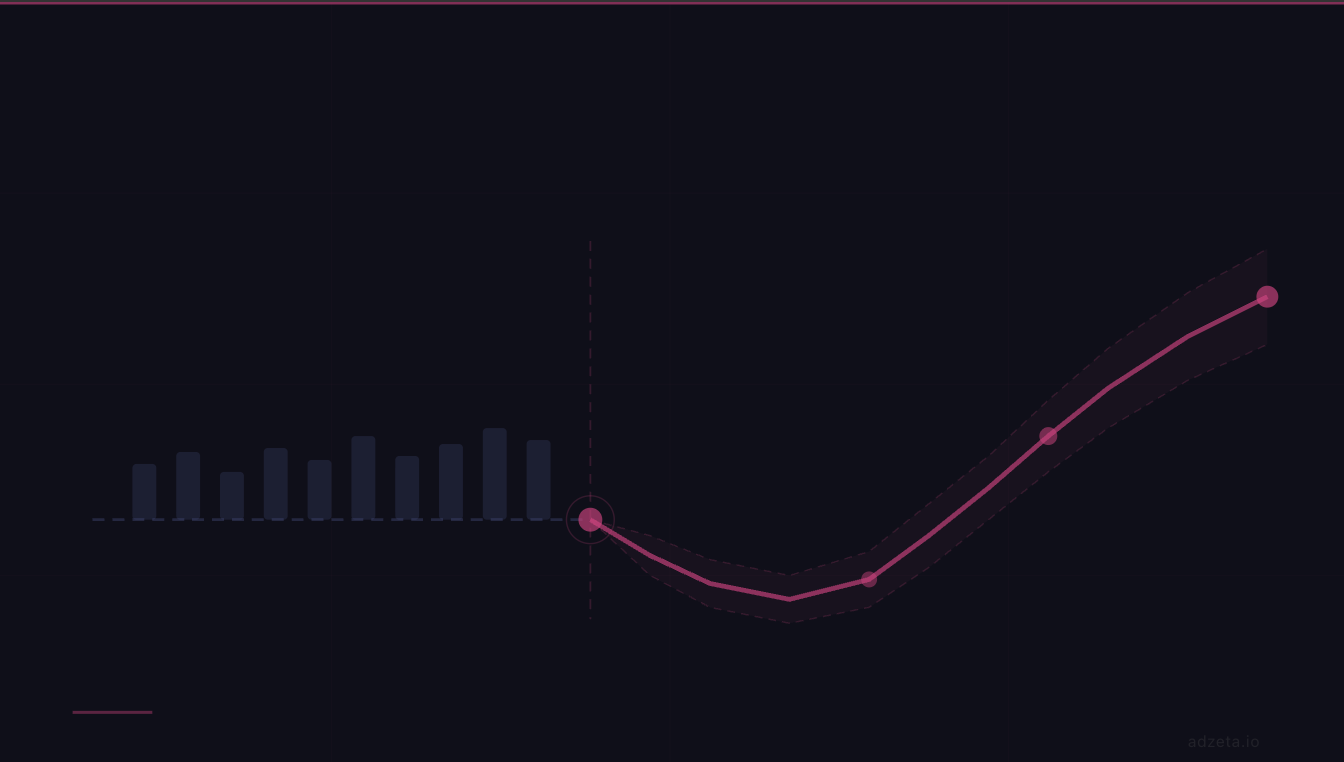
Every time you switch bid strategy, change the conversion signal, or move from AOV-based to pLTV-based bidding, Google Smart Bidding enters a learning period. During this period the algorithm re-evaluates auction patterns with the new objective. Performance fluctuates. ROAS may dip 10 to 20% in the first two weeks. Conversion volume often pulls back. These are not signs that the change was a mistake: they are documented, expected consequences of recalibration that appear in Google's own support documentation.
The problem is that most DTC growth teams interpret these early-phase metrics as failure signals and revert the change before the algorithm has completed its learning cycle. Each reversion resets the learning period. Brands that cycle through signal changes without holding any of them for a full learning window never accumulate the sustained signal history that makes Smart Bidding effective. According to Google's documentation, learning requires up to 50 conversion events or 3 full conversion cycles: and reversions restart that clock entirely.
This guide covers the four phases of the Smart Bidding learning period, what happens in each phase and why, what to monitor versus what to leave completely alone, the three triggers that start a new learning period, and why pLTV signal changes via OCI require a longer commitment window than standard bid strategy switches. The Google Smart Bidding LTV signals setup guide covers the technical implementation; this article covers what to expect after the switch is made.
In This Article
- 1What the Learning Period Actually Is
- 2The Three Triggers That Start a New Learning Period
- 3The Four Phases: What Happens Week by Week
- 4What to Monitor vs What to Leave Alone
- 5Why pLTV Signal Changes Require a Longer Window
- 6How to Set Your Review Date Correctly
- 7The Six Mistakes That Reset or Extend Learning
- 8How to Evaluate Performance After Learning Completes
- 9Further Reading
What the Learning Period Actually Is
Google Smart Bidding is a prediction engine. At every auction it predicts what conversion value a click will produce and sets a bid based on that prediction. The prediction model is trained on historical data: which clicks from which users in which contexts led to conversions of which value. When you change the conversion signal (switching from AOV to pLTV), change the bid strategy (tCPA to tROAS), or significantly change campaign structure, the model's existing predictions become less accurate for the new objective. The learning period is the window during which the model re-calibrates.
The Learning status indicator in Google Ads shows three distinct causes when it appears: New strategy (bid strategy was recently created or reactivated), Setting change (a setting for the bid strategy was changed), or Composition change (campaigns, ad groups, or keywords were added to or removed from the bid strategy). Each of these causes a full learning period reset. Understanding which trigger applies to your situation determines how long to expect the learning window to last and which specific metrics to watch.
The Three Triggers That Start a New Learning Period
Bid strategy switch
Switching from one automated strategy to another: from Target CPA to Target ROAS, from Maximize Conversions to Maximize Conversion Value: always triggers a full learning period. The algorithm is recalibrating to a different objective function. This is the most common trigger for DTC brands moving through the VBB progression from tCPA to tROAS to pLTV-based value signals.
Target or signal change
Changing the tROAS target significantly (more than 15 to 20%), changing the conversion action the strategy optimises toward, or switching the value signal from checkout AOV to pLTV via OCI all trigger a new Learning status. For signal changes specifically, Google's VBB documentation recommends uploading new values for 4 weeks or 3 conversion cycles before activating value-based bidding: the learning window begins when you activate, not when you start uploading.
Campaign structure changes
Adding or removing campaigns from a portfolio bid strategy, significantly expanding or contracting keyword sets, and adding new ad groups all trigger the Composition change variant of Learning status. For DTC brands this typically occurs during seasonal restructuring. Timing these changes to coincide with a planned signal switch consolidates the learning periods rather than stacking them sequentially.
The Four Phases: What Happens Week by Week
The learning period does not have a single uniform character. It progresses through four distinct phases, each with different performance characteristics and appropriate actions. The phase timeline below is based on Google's published learning period documentation and patterns observed across accounts running pLTV signal transitions.
Phases 1 and 2 require patience that most dashboards are not designed to encourage. When weekly ROAS reports show a 15% decline, the instinct is to adjust the target or revert the strategy. Google's guidance on measuring Smart Bidding performance is explicit: do not compare recent performance to past performance during this window because conversion delay means recent data systematically understates results. The clicks that happened in week 1 are still converting in week 3, and those conversions attribute back to week 1 in the bid strategy report.
What to Monitor vs What to Leave Alone
The distinction between what requires active monitoring and what requires complete non-interference is the most operationally important part of managing a learning period. Google's Smart Bidding management documentation recommends waiting at least 2 weeks without changes for the initial learning period, and notes that significant campaign changes can disrupt performance because the algorithm needs to re-learn the new settings.
The bid strategy report is the correct tool for performance assessment during learning: not the main Campaigns dashboard. Navigate to Campaigns, select a campaign, then Bid strategy type, then View bid strategy details. The report shows actual ROAS plotted against target ROAS, with notes for conversion delay and learning periods. A gap between actual and target that is closing week-on-week is normal learning behaviour. A gap that is widening indicates a potential signal or tracking issue worth investigating.
Why pLTV Signal Changes Require a Longer Window
Standard bid strategy switches: tCPA to tROAS: typically complete learning within 4 to 6 weeks for accounts with adequate conversion volume. pLTV signal changes via OCI require a meaningfully longer commitment window for two reasons. First, the signal itself takes time to accumulate: pLTV scores are generated at first purchase and uploaded daily, but the algorithm needs enough pLTV-tagged conversions to build a reliable model of which audience profiles correlate with high predicted lifetime value. Second, pLTV values are forward-looking predictions that the algorithm has not previously seen as conversion values: it is learning an entirely new objective, not just recalibrating to a different cost or return target.
Google's VBB for Search documentation states explicitly: "Upload values once you're bidding to your desired conversion goal, upload values for 4 weeks or 3 conversion cycles, whichever is longer, before activating value-based bidding." For OCI-based pLTV, delays in uploading conversions beyond 7 days post-click are noted as potentially extending the ramp-up period to several months. This is the key operational risk for DTC brands building their first pLTV pipeline: upload latency compounds directly into learning period length.
The practical implication: for pLTV signal transitions, set a minimum 8-week hold period before performance evaluation. Use weeks 1 through 7 to monitor OCI upload health, conversion tracking diagnostics, and pLTV score distribution (are the values varied and non-uniform?). The week-8 review should assess both ROAS recovery and early cohort quality data: specifically, the 30-day repeat purchase rate of customers acquired since the signal switch compared to the pre-switch cohort baseline. That cohort comparison is the actual validation metric, not the ROAS dashboard. The pLTV bidding on Google guide covers how to structure this comparison correctly.
How to Set Your Review Date Correctly
Identify your average conversion cycle length before switching
Your conversion cycle is the average time from ad click to final reported conversion. Check Tools, then Measurement, then Attribution in Google Ads, and look at conversion delay reporting. If 90% of conversions report within 7 days, your conversion cycle is approximately 7 days. If conversions trickle in over 21 days, your cycle is 21 days. The learning period requires 3 full conversion cycles, so multiply your cycle length by 3 to get your minimum hold window.
Calculate your review date at switch time: before Phase 1 begins
Set the review date on the day of the switch. If your conversion cycle is 14 days and you need 3 cycles, your minimum review date is 42 days out. Add 7 days buffer for conversion delay. Write this date down and share it with anyone who will see the performance dashboard. The review date exists to prevent phase 1 and 2 performance data from triggering premature reversions.
Use the bid strategy report, not the campaign dashboard, for the review
At the review date, navigate to the bid strategy report. Set the date range to cover the full period since the switch. Look at the actual vs target ROAS chart for direction, not week-one values. A healthy learning completion shows actual ROAS converging toward or exceeding the target in the most recent 2 to 3 weeks of the report. If actual ROAS is still below target but trending upward, extend the hold by one more conversion cycle.
Add cohort quality to the review checklist for pLTV transitions
For pLTV signal switches, the ROAS report alone does not validate success. Pull a cohort comparison: customers acquired in the 30 days before the switch vs customers acquired in the most recent 30 days. Compare 30-day repeat purchase rate. A successful pLTV transition should show an improvement in early cohort repeat behaviour: not just ROAS recovery: because the algorithm has been optimising toward high-predicted-LTV profiles for the full learning window.
The Six Mistakes That Reset or Extend Learning
Reverting the bid strategy in weeks 1 or 2
The most common and most damaging mistake. A phase 1 ROAS dip is documented, expected behaviour. Reverting resets the learning period entirely and means the algorithm never accumulates the signal history needed to demonstrate the full value of the new objective. If the reversion happens repeatedly, the account perpetually re-enters learning without ever completing a cycle.
Adjusting the tROAS target during learning
Changing the tROAS target mid-learning cycle makes it harder for the algorithm to assess performance against a consistent goal. Google's documentation specifically warns against multiple tROAS target changes within a single conversion cycle. If the initial target was set incorrectly, make a single correction at week 3 and then hold through the remainder of the cycle.
Uploading OCI values infrequently or with delays
For pLTV transitions, upload frequency is a direct input into learning period length. Daily uploads are optimal. Weekly uploads slow learning measurably. Uploads beyond 7 days post-click may not reach Smart Bidding before the GCLID context degrades. Build the OCI pipeline to upload within 24 to 48 hours of purchase and monitor upload health every 3 to 5 days during the first 8 weeks.
Running creative tests during the learning window
Major creative refreshes trigger performance changes that are difficult to separate from learning period noise. Creative test results pulled during a learning period produce unreliable data because the algorithm is simultaneously adjusting to both the new bidding signal and the new creative. Reserve significant creative changes for the period after the review date confirms learning has completed.
Making structural changes while Learning status is active
Adding keywords, expanding match types significantly, restructuring ad groups, or adding new campaigns to a portfolio strategy all trigger a Composition change that resets the Learning status. If structural changes are needed, batch them into a single event rather than making them incrementally, and accept that each batch restarts the learning clock.
Evaluating on ROAS alone for pLTV transitions
A pLTV transition evaluated only on ROAS will sometimes appear to underperform a pure AOV setup in weeks 1 through 6, because the algorithm is intentionally acquiring customers that the AOV signal would have deprioritised. These customers: lower first-order spenders with high subscription conversion probability: produce lower immediate ROAS but better LTV:CAC. Evaluating without cohort quality data produces the wrong conclusion.
How to Evaluate Performance After Learning Completes
The correct evaluation window is at least 2 full conversion cycles of post-learning data: not the entire period since the switch, which includes learning period noise. Set your report date range to start on the review date (when learning completed) and end at least 14 days later, or longer if your conversion cycle exceeds 7 days. Compare actual ROAS against target ROAS using the bid strategy report, and compare conversion volume to the equivalent pre-switch period adjusted for any seasonal differences.
For value-based bidding transitions specifically, the correct success metric is LTV:CAC per acquisition cohort, not campaign ROAS. Pull the cohort of customers acquired in the 4 weeks after learning completed and compare their 30-day and 60-day repeat purchase rates to the pre-switch baseline cohort. A successful pLTV transition should show the post-learning cohort outperforming the baseline on repeat rate, even if first-order ROAS is comparable or slightly below.
Smart Bidding Exploration becomes available as an additional lever once learning has completed and tROAS is stable. It instructs the algorithm to test higher bids on traffic segments outside its current high-confidence zone, producing an 18% average increase in unique search query categories with conversions. Enable it only after the post-learning evaluation confirms stable performance: it has its own 1 to 2 week ramp-up period that should not overlap with an ongoing learning period assessment.
Key Takeaways
- The Smart Bidding learning period requires up to 50 conversion events or 3 full conversion cycles. During phases 1 and 2 (weeks 1 to 4), performance fluctuations are expected and documented. Phase 1 ROAS dips are not failure signals.
- Three triggers start a new learning period: bid strategy switch (New strategy), target or signal change (Setting change), and campaign structure change (Composition change). Understanding which applies determines how long to hold before evaluating.
- For pLTV OCI signal transitions, the minimum hold period is 8 weeks, not 4 to 6. Upload latency beyond 7 days post-click extends the ramp-up significantly. Daily OCI uploads are optimal.
- The single most damaging mistake is reverting the bid strategy in weeks 1 or 2. Each reversion resets the learning clock. Accounts that cycle through signal changes without completing a learning window never accumulate the signal history that makes the strategy effective.
- Set the review date on the day of the switch, before phase 1 begins. Use the bid strategy report, not the campaign dashboard, for the evaluation. For pLTV transitions, add cohort repeat purchase rate comparison to the review checklist alongside ROAS.
- Smart Bidding Exploration should be enabled after learning completes and post-learning performance is confirmed stable: not during the learning window. It has its own 1 to 2 week ramp-up that stacks onto an ongoing learning period if activated too early.
Further Reading
Google Smart Bidding With LTV Signals: How to Set It Up in 2026: the three technical paths for passing LTV signals into Smart Bidding, OCI setup, and the GCLID capture requirements that determine whether pLTV values reach the platform.
Value-Based Bidding vs Target CPA: Which Strategy Is Right for Your DTC Brand: the correct progression from tCPA to tROAS to pLTV signals, including the conversion volume requirements and the sequencing mistakes that produce extended learning instability.
pLTV Bidding on Google Ads: Step-by-Step Guide for DTC Brands: full technical implementation of pLTV signals via OCI, Customer Match tiers, and Conversion Value Rules.