
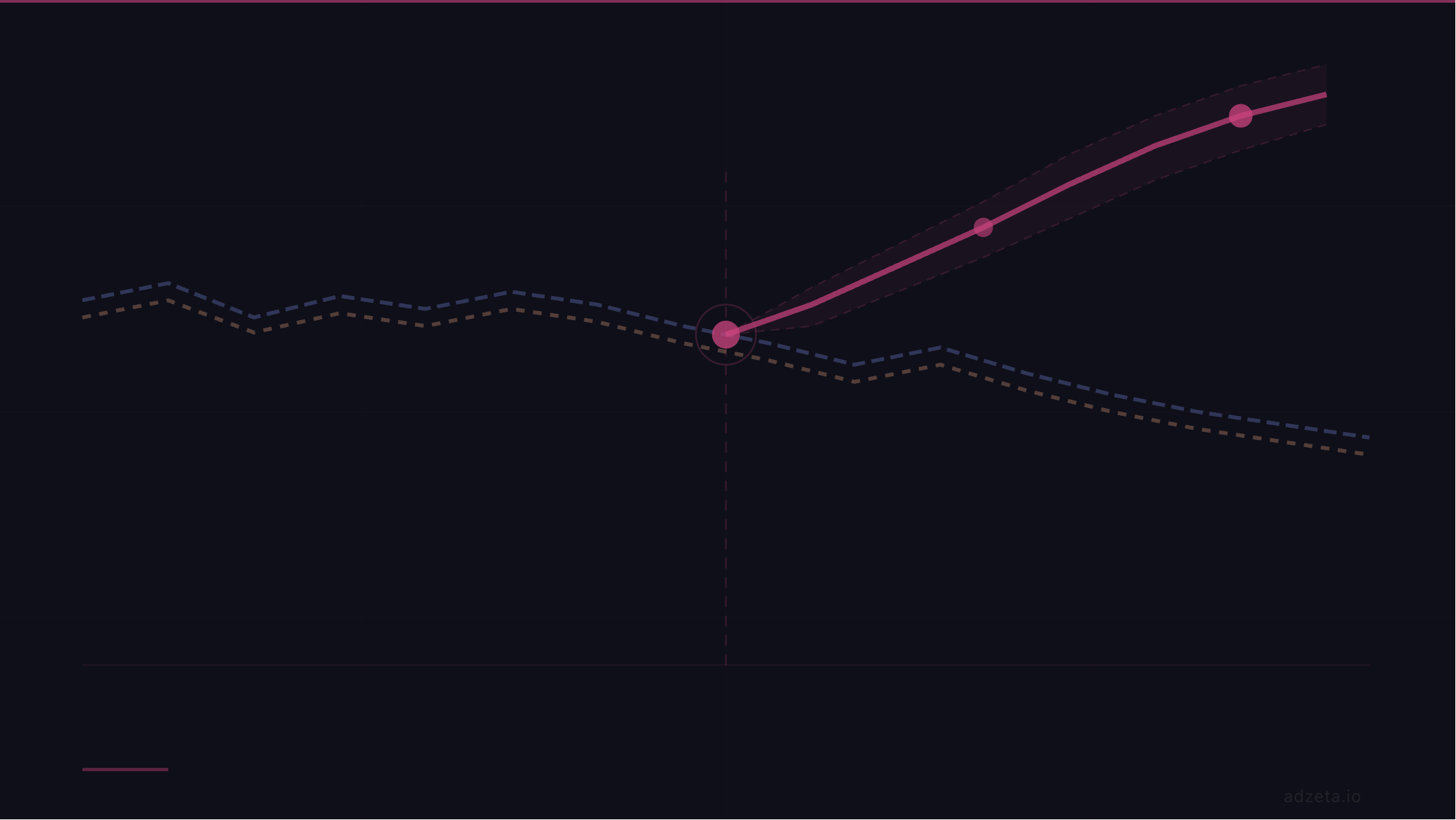
Meta CPCs hit a 12-month low in the week of February 1, 2026. Northbeam's Media Buyer Newsletter published the data: cost-per-click across their aggregate dataset had been declining for 16 months. Most growth teams read this as tailwind. Cheaper impressions, more volume at the same budget, better efficiency.
The CVR chart tells a different story. Conversion rates across the same period fell in near-perfect lockstep with CPCs. Cheaper clicks that convert at half the rate produce an identical CPA. The efficiency gain the CPC headline implied does not exist in the math. What the data actually shows is two metrics declining in parallel across the same period, moving together in a way that only happens when a structural mechanism is causing both.
That mechanism is Andromeda, Meta's AI-powered ad retrieval engine, rolled out fully by October 2025. It replaced the audience-based targeting model with a creative-based one. As more advertisers run the same Advantage+ automation stack with structurally converging creatives, the system routes spend toward overlapping user pools. Competition per user thins. CPCs fall. But the conversion objective every brand feeds the auction is still the same: AOV checkout events. The system is selecting users against a signal that treats a one-time $42 buyer and a repeat subscriber identically. The auction rewards whoever converts cheapest. This piece covers exactly why that is the real problem, and why the fix is not creative diversity.
In This Article
- 1The CPC Headline and the CVR Data Nobody Talks About
- 2What Andromeda Actually Changed
- 3Why Converging Automation Compresses Both CPC and CVR Together
- 4The Two Stages of the Meta Auction
- 5Creative Diversity Solves Stage 1. It Does Not Touch Stage 2.
- 6The Signal That Competes for a Different Customer
- 7What pLTV Does at the Ranking Stage
- 8Further Reading
The CPC Headline and the CVR Data Nobody Talks About
When CPCs fall 30% and CVRs fall 30% simultaneously, the CPA is flat. Volume at budget is flat. The efficiency of the account has not changed at all. The only thing that changed is the cost structure of the transaction: cheaper clicks, fewer of them converting. The Northbeam data shows exactly this pattern across 16 months of aggregate ecommerce spend on Meta. Industry-wide benchmarks from Triple Whale confirm the same directional trend: conversion rates across Meta declined materially in 2025 even as click costs moderated.
The chart below reconstructs this relationship from the published trend data. The two lines move together with a consistency that rules out seasonal noise or vertical-specific anomalies. This is a structural relationship, not a coincidence.
The mechanism producing this lockstep is not a mystery once you understand what Andromeda changed. The retrieval system now routes ads to user pools based on creative characteristics. As the creative landscape converges toward the same formats and automation tools, more advertisers are competing for the same audience segments. That specific dynamic reduces competition within each user pool, lowering CPCs. But those user pools are being selected based on creative matching, not conversion value matching. The users are cheaper to reach. They are not more likely to convert, and they are not more likely to return.
What Andromeda Actually Changed
Andromeda is Meta's ad retrieval engine, announced by Meta's Engineering team in December 2024 and deployed fully across all objectives and placements by October 2025. It replaced rule-based audience targeting with deep neural network retrieval. The system processes tens of millions of ad candidates and narrows them to roughly 1,000 that are eligible to enter the ranking auction. The mechanism it uses to do this changed fundamentally.
Under the previous system, retrieval was governed primarily by audience targeting: who the advertiser specified as the target, and which users were in those audience segments. Under Andromeda, retrieval is governed primarily by creative: the system reads the ad creative itself: visual content, tone, format, semantic content: and predicts which users are most likely to engage based on behavioural signals, independently of the audience the advertiser defined. Manual audience targeting now functions as a soft bias rather than a hard constraint.
The practical effects began appearing in Q4 2025: broad targeting outperforming lookalike stacks, creative-driven performance variance replacing audience-driven variance, and simplified campaign structures (fewer ad sets, more creative diversity per ad set) outperforming complex hierarchical setups. These are the signatures of a retrieval system that is reading creative rather than reading audience specifications.
Why Converging Automation Compresses Both CPC and CVR Together
When every brand in a vertical runs Advantage+ Sales Campaigns with broadly similar creative formats, Andromeda's creative-matching logic routes their ads toward overlapping user segments. The users in those segments see higher ad frequency from structurally similar brands. Creative similarity above a 60% threshold triggers retrieval suppression: Andromeda treats near-identical creative variations as a single entity, reducing auction entry for redundant creative sets.
The result is that the user pools each brand reaches are increasingly the same pools reached by every competitor running the same automation with the same creative approach. Competition within those pools decreases: hence the CPC decline. But those pools are selected for creative relevance, not purchase intent or LTV profile. The users are cheaper to reach precisely because they are being reached by everyone, and the creative-to-user matching is not selecting for buyers whose lifetime economics justify the acquisition cost.
This is the structural mechanism behind the lockstep. CPCs fall because competition thins in the creative-matched user pools. CVRs fall because those pools are not selected for conversion probability or value: they are selected for creative relevance. The two move together because they are both downstream of the same retrieval logic.
The Two Stages of the Meta Auction
Understanding why creative diversity is not the complete answer requires understanding that the Meta auction operates in two distinct stages with different optimization levers at each.
Stage 1: retrieval: is where Andromeda operates. It is the gatekeeper: if the creative does not produce a retrieval ticket, the ad never competes. Creative diversity, freshness, and conceptual distinction determine how many retrieval tickets an advertiser gets and which user segments those tickets cover. This is the stage the industry conversation has correctly identified as changed.
Stage 2: ranking: is where conversion value operates. Once the thousand-odd candidates have cleared retrieval, the auction ranking formula applies: bid multiplied by predicted conversion probability multiplied by conversion value. The conversion value in this formula comes directly from the purchase event signal the advertiser has configured. It is the number that determines which customer the system is actually competing to acquire.
Creative Diversity Solves Stage 1. It Does Not Touch Stage 2.
The industry guidance that emerged from Andromeda is largely correct for Stage 1: more conceptually distinct creative assets, launched at higher velocity, give the retrieval engine more combinations to test and wider user segment coverage. Brands that produced 10 to 15 genuinely distinct creative concepts per Advantage+ campaign saw retrieval performance improve meaningfully through late 2025.
But creative diversity has no mechanism to change what happens at Stage 2. The ranking formula does not read the creative. It reads the conversion value the advertiser sends via pixel or CAPI. A brand with exceptional creative diversity and an AOV checkout event is competing at the ranking stage with a signal that treats every buyer identically by their first-order spend. The system finds the users who look like profiles that convert cheaply against that signal. Those users are not the same users a pLTV signal would find.
The gap that creative cannot close
Two brands with identical creative quality and creative diversity, running identical Advantage+ campaigns, competing in the same auction. One passes AOV checkout value as the conversion signal. One passes predicted 12-month customer revenue via CAPI. The ranking formula treats their bids differently because the conversion value field is different. They are competing for fundamentally different customers. Creative quality is irrelevant to that difference.
The Signal That Competes for a Different Customer
When the conversion value field in a CAPI purchase event contains predicted 12-month revenue rather than checkout AOV, the ranking formula changes what it is optimizing toward. Meta's value optimisation uses the value field to learn which audience profiles produce high-value conversions. With AOV, high-value means high first-order spend. With pLTV, high-value means customers whose early behavioural signals predict strong downstream revenue: subscription conversion, repeat purchase, category loyalty.
The specific profiles these two objectives find are meaningfully different in replenishment categories. A supplement brand optimising on AOV finds users who spend the most on a single order. A supplement brand optimising on pLTV finds users who buy a modest first order and then subscribe. The first-order amounts are lower. The 12-month revenues are 4x to 8x higher. The auction rewards the first brand for finding big first-order spenders. It rewards the second brand for finding the customers who are still buying 18 months later.
This distinction is invisible to creative quality. The brand with better creative and AOV signals, and the brand with better creative and pLTV signals, are not competing for the same customer in the ranking stage. The CPC and CVR environments they operate in are therefore not comparable: different value signals attract different user pools at the ranking stage, and those pools have different conversion rates and downstream revenue profiles.
What pLTV Does at the Ranking Stage
The implementation is a pipeline, not a campaign change. pLTV for Meta flows through CAPI: an ML model scores each customer's predicted 12-month revenue at or within days of first purchase, and that score is passed as the value parameter in the CAPI purchase event rather than the checkout transaction amount. Meta's value optimisation then uses this score as the training signal that governs delivery and ranking toward high-value buyer profiles.
The practical effect is that the auction the brand is competing in shifts. Instead of competing for cheap converters, the bid is calibrated to the predicted 12-month value of the customer being acquired. Brands bidding more aggressively for customers predicted to be worth $247 over 12 months are not competing against brands bidding efficiently for $47 first-order converters. The user pools are different. The auction dynamics are different. The CVR for pLTV-optimised campaigns is typically lower than AOV-optimised campaigns for the same vertical: because the brand is not chasing cheap conversions: but the downstream LTV:CAC is structurally better.
The Andromeda environment makes this distinction more important, not less. As Andromeda flattens CPC across advertisers competing in the same creative-matched user pools, the differentiation that remains at Stage 2 is entirely signal quality. The brands that will diverge from the CPC/CVR lockstep are the ones that have decoupled their ranking stage objective from the commodity signal that every competitor is also using. The Advantage+ pLTV setup guide covers the specific configuration and the CAPI pipeline that makes this possible at scale.
Key Takeaways
- Meta CPCs and CVRs have been declining in near-lockstep for 16 months. The efficiency gain implied by a CPC headline that does not show the CVR chart is not real: cheaper clicks converting at proportionally lower rates produce the same CPA.
- Andromeda, Meta's creative-based retrieval engine deployed fully by October 2025, is the structural mechanism. As advertisers converge on similar automation stacks and creative formats, Andromeda routes spend toward overlapping user pools. CPCs fall because competition thins. CVRs fall because those pools are selected for creative relevance, not conversion value.
- The Meta auction has two stages: retrieval (Stage 1, governed by creative) and ranking (Stage 2, governed by conversion value signal). Creative diversity solves Stage 1. It has no mechanism to affect Stage 2.
- At the ranking stage, the formula is: bid x predicted conversion probability x conversion value. What the advertiser passes as the conversion value determines which customer the system is competing to acquire: a cheap first-order converter or a predicted 12-month high-value buyer.
- Two brands with identical creative quality running in the same Andromeda environment, one passing AOV and one passing pLTV via CAPI, are not competing for the same customer at Stage 2. The gap between their downstream LTV:CAC cannot be closed by better creative on either side.
- The Andromeda environment makes signal quality more important, not less. As Stage 1 performance equalises across advertisers who have all adopted creative diversity, the remaining differentiation is entirely at Stage 2: the conversion value field that governs which customer the ranking formula is calibrated to find.
Further Reading
pLTV Bidding on Meta Ads: What Actually Works in 2026: the technical implementation of pLTV signals via CAPI, including the value field configuration and Event Match Quality requirements.
Meta Advantage+ Sales Campaigns With pLTV: The Complete Setup Guide: how pLTV signals flow through CAPI into Advantage+ value optimisation, the learning period mechanics, and the five configuration mistakes that prevent full benefit.
How Value-Based Bidding Works on Meta: Setup Guide for 2026: CAPI configuration, the Highest Value to ROAS Goal progression, and the complete value optimisation activation sequence.