
What This Guide Covers
- 1How Meta's Auction Values a Conversion
- 2The 7-Day Attribution Ceiling and What It Costs You
- 3CAPI Architecture: The Signal Foundation for LTV Bidding
- 4Event Match Quality: The Metric Nobody Talks About Enough
- 5Value Rules vs True pLTV Bidding: A Technical Distinction
- 6Building Your pLTV Signal Pipeline for Meta
- 7Advantage+ and pLTV: How to Steer Andromeda Without Losing Automation
- 8Measurement Framework: What Actually Improved
- 9Further Reading from AdZeta
Meta's Value Optimization is a genuinely sophisticated bidding system. It uses machine learning to predict which users will generate higher conversion value and bids proportionally in real time. The limitation is not the algorithm. The limitation is the signal the algorithm is allowed to see.
By default, Meta Value Optimization optimizes against purchase events observed within a 7-day click or 1-day view attribution window. For most DTC and eCommerce brands, a customer's true value does not reveal itself in 7 days. A subscription renewal, a second product category purchase, or a retention signal that predicts 12-month LTV takes 30 to 90 days to materialize.
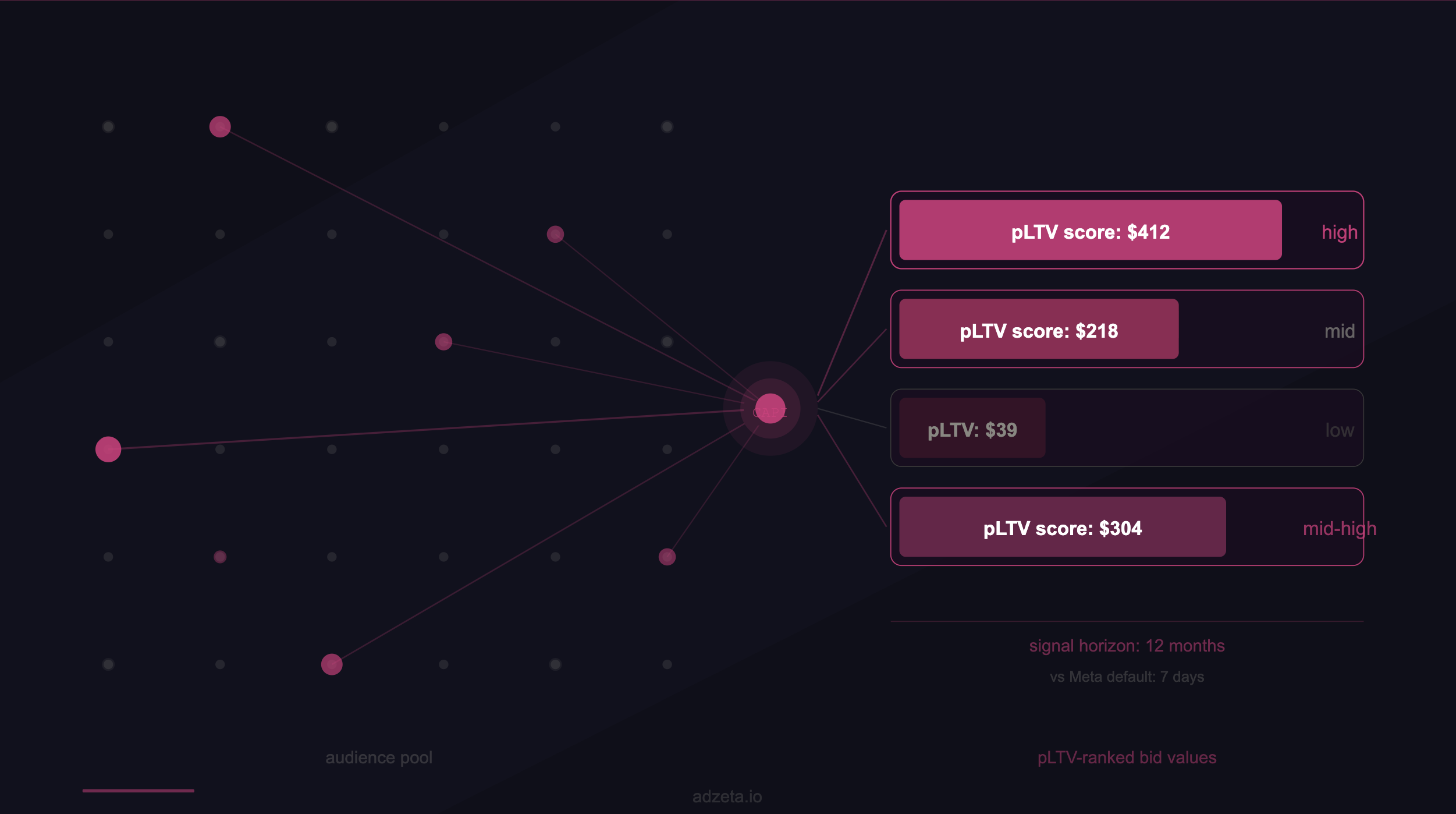
pLTV bidding on Meta addresses this ceiling at the signal level, not the campaign settings level. Instead of waiting for actual repeat behavior to surface within a 7-day window, a trained ML model scores each new customer on predicted 12-month value and passes that score to Meta as the conversion value via the Conversions API. Andromeda, Meta's ad ranking engine, then optimizes toward profiles associated with that predicted long-term value rather than immediate transaction size.
Who This Guide Is For
This is a technical implementation guide for growth engineers, data scientists, and performance marketing leads at DTC and eCommerce brands spending $50K or more monthly on Meta. It covers signal architecture, CAPI configuration, EMQ scoring, Value Rules vs pLTV distinctions, and Advantage+ steering.
How Meta's Auction Values a Conversion
Meta's auction uses a predicted value formula to determine which ads serve to which users. Per Meta's business documentation on value optimization, the system estimates the expected revenue each impression is likely to generate and bids proportionally based on that estimate and your campaign's efficiency target.
The predicted value calculation uses three inputs: the probability of a conversion event occurring, the expected value of that conversion given that it occurs, and the ROAS target you have set. This is structurally identical to Google's tROAS auction formula. The critical variable is what populates the expected conversion value. By default, Meta uses the average transaction value reported within its attribution window. That default is where the signal failure begins.
The 7-Day Attribution Ceiling and What It Costs You
The Meta Conversions API documentation describes the attribution window as the period after a click or view during which a conversion event is credited to that ad. The maximum for click-through attribution is 7 days. This is a measurement constraint that also functions as an optimization constraint: the algorithm can only learn from value signals that occur within that window.
For a brand where the average customer makes a second purchase within 45 days, the algorithm has no training signal from that second purchase. For a subscription business where the primary revenue event is a renewal at day 30, the algorithm is optimizing against a proxy, not the actual value event. For a skincare or beauty brand where regimen adoption develops over 60 to 90 days, the 7-day window captures only the trial purchase, not the retention outcome.
The practical consequence is that Meta's algorithm gets better over time at finding people who make first purchases of a given transaction size. It does not get better at finding people who will become retained customers, expand their product usage, or generate high 12-month LTV. Scaling spend under this constraint does not scale customer quality. It scales the acquisition of the same undifferentiated profile at higher CPMs.
CAPI Architecture: The Signal Foundation for LTV Bidding
The Meta Conversions API is a server-to-server integration that sends conversion events directly from your infrastructure to Meta's systems, bypassing browser-based tracking entirely. Understanding CAPI's architecture is prerequisite to understanding how pLTV signals reach Meta's bidding layer.
Browser-based tracking via the Meta Pixel relies on JavaScript firing in the user's browser at the moment of a qualifying event. Since Apple's ATT rollout in 2021, advertisers relying solely on the Pixel see a 61 to 72% drop in reported mobile conversions, as documented by Rockads based on Meta's own data. CAPI addresses this by operating at the server level, entirely independent of browser restrictions, ad blockers, and iOS consent states.
The LTV signal flows through CAPI as the value parameter of a purchase event. Where a standard CAPI implementation sends the transaction amount ($84) as the conversion value, a pLTV implementation sends the model-generated predicted LTV score ($412) instead. Meta's Andromeda engine receives this score as the optimization target and trains toward customer profiles associated with that predicted value rather than the transaction size.
Event Match Quality: The Metric Nobody Talks About Enough
Event Match Quality (EMQ) is Meta's internal scoring metric that measures how accurately the conversion events you send can be matched to actual Facebook users. Scored from 0 to 10, EMQ directly determines how many of your conversion events are used for optimization. A low EMQ means Meta's algorithm trains on a fraction of your actual conversion data, regardless of how accurately your CAPI is firing.
EMQ is determined by the richness of the hashed first-party identifiers sent with each event. Sending only a hashed email produces an EMQ of 2 to 4. Adding phone number moves it to 5 to 6. Adding IP address and user agent reaches 7 to 8. At EMQ 7 or above, Meta's documentation confirms meaningful improvements in ad delivery optimization and attribution accuracy. Adding a pLTV score as the conversion value at this signal quality level gives Andromeda both a high-fidelity match and a high-fidelity optimization target simultaneously.
Check Your EMQ Before Injecting pLTV Scores
Injecting a pLTV conversion value into a CAPI integration with an EMQ below 6 produces poor results. Meta cannot match low-EMQ events to real users reliably, so the pLTV signal reaches an incomplete user population. Fix EMQ first by adding phone number and IP address to your event payloads, then layer in pLTV conversion values. Attempting to improve bidding quality with a weak signal foundation produces unreliable optimization.
Value Rules vs True pLTV Bidding: A Technical Distinction
Meta launched Value Rules in June 2025 as a mechanism to apply bid multipliers to specific audience segments based on demographic characteristics: age, gender, location, device type, and placement. A brand can specify that impressions to women aged 25 to 34 should be valued at a 20% premium. This is a meaningful improvement over uniform bidding. It is not the same as pLTV bidding and the distinction matters operationally.
Value Rules operate at the segment level. Every woman aged 25 to 34 in your ruleset receives the same bid multiplier, regardless of her individual behavioral profile. A customer whose browsing pattern predicts $680 in 12-month LTV and a customer whose pattern predicts $42 are treated identically if they share the same demographic segment. pLTV bidding operates at the individual level. Each conversion event carries a unique model-generated score, not a segment assumption.
The practical implication: as Jon Loomer documents in his 2025 Meta advertising changes analysis, Value Rules are most effective when combined with a true value optimization signal. The recommended architecture is pLTV scores as the base conversion value via CAPI, with Value Rules applied on top to handle categorical adjustments where individual scoring cannot reach, such as geographic pricing differences or known high-margin product lines.
Building Your pLTV Signal Pipeline for Meta
The pipeline connecting your first-party customer data to Meta's bidding layer has four components that must work in sequence. Each component has a clear output that gates the next stage. The most common implementation failure is attempting to activate a pLTV signal before the upstream components are validated.
Unify and validate your first-party event data
Pull purchase history, behavioral events (product views, add-to-cart, category browsing), email engagement, and subscription signals into a unified customer table in your data warehouse. Validate completeness across a 12-month lookback window. Confirm that your Meta click IDs (fbclid) and external IDs are stored at the order level, as these are required to link offline conversion events back to Meta campaigns.
Train your pLTV model on historical cohort data
Train on cohorts where 12-month revenue outcomes are already observed. Use a temporal train and test split: cohorts acquired before your cutoff date for training, cohorts acquired after for evaluation. The five most predictive early features for DTC and eCommerce brands are time to second purchase, product category breadth in the first 30 days, AOV direction from order one to order two, lifecycle email click rate before repurchase, and acquisition source channel. Evaluate using Spearman rank correlation rather than MAE alone. A model with strong rank accuracy at the top and bottom of the value distribution performs better in production than one optimized for mean error.
Score new customers and generate pLTV conversion values
Run inference on new customers within hours of their first qualifying behavioral event. The score updates as new signals arrive. At day 7, prediction accuracy reaches 85% or above based on early behavioral patterns, before a second purchase has occurred. This is the operative advantage: you can bid on a customer's predicted 12-month value on day one of their relationship with your brand.
Push pLTV scores to Meta via CAPI as conversion values
Send the pLTV score as the value parameter of the purchase conversion event payload via CAPI. Include the maximum available identifier set (hashed email, phone, external_id, fbclid, IP, user agent) to maximize EMQ. Use a shared event_id between your Pixel and CAPI payloads to enable deduplication. Validate signal receipt and EMQ in Meta Events Manager before evaluating campaign-level impact.
Configure campaign objectives and learning period management
Set your campaign objective to Value optimization with a minimum ROAS target. Per Meta's algorithm stability guidelines, set an initial minimum ROAS 15 to 20% below your historical average to allow the algorithm to gather sufficient conversion events during the learning phase. Meta requires 50 conversion events per week to exit the learning phase for value optimization campaigns. If your volume is below this threshold, start with Maximize Conversion Value without a ROAS floor and introduce the floor after the learning phase stabilizes.
Advantage+ and pLTV: How to Steer Andromeda Without Losing Automation
Meta's Advantage+ Shopping Campaigns automate targeting, placements, creative testing, and budget allocation simultaneously. The Andromeda ranking engine underlying Advantage+ optimizes all of these dimensions against a single optimization signal. When that signal is a pLTV conversion value rather than transaction AOV, Andromeda's automation amplifies the LTV signal across all surfaces rather than working against it.
The correct architecture for most DTC brands is: run Advantage+ campaigns with value optimization enabled, with CAPI supplying pLTV scores as conversion values, and Value Rules applied on top for categorical adjustments where relevant. This configuration lets Andromeda handle broad audience discovery and creative placement while the pLTV signal steers the algorithm's learning toward your highest-value customer profiles rather than your most frequent transactors.
During the learning phase, suppress the urge to evaluate campaign performance on in-platform ROAS. Meta's own guidance on Advantage+ learning phases confirms that in-platform reported ROAS during the first 3 to 5 weeks reflects the algorithm's exploration behavior, not its optimized state. The correct evaluation window is 8 to 12 weeks, measured against 90-day cohort revenue per acquired customer in your own data warehouse, not the Ads Manager dashboard.
Measurement Framework: What Actually Improved
The correct measurement framework for a pLTV Meta implementation is not in-platform ROAS, reported conversion value, or Meta's estimated revenue. All three reflect the pLTV score you injected, not the actual downstream customer revenue. In-platform ROAS will look better because you replaced $84 AOV with $412 pLTV scores. That improvement is real only if the model's predictions prove accurate in cohort outcomes.
| Metric | What It Measures | Correct Direction | Window |
|---|---|---|---|
| 90-day revenue per acquired customer | Whether pLTV signal selects higher-value customers | Up vs pre-pLTV baseline cohort | Compare 90-day cohorts, 60 days post-launch |
| In-platform reported ROAS | Ratio of injected pLTV scores to spend (not actual revenue) | Ignore during evaluation period | Lagging indicator only |
| EMQ score in Events Manager | Signal quality reaching Meta's algorithm | Above 7 for reliable optimization | Weekly check during first 30 days |
| LTV:CAC ratio by campaign | Whether pLTV-signaled campaigns acquire better profiles | Up vs standard Value Optimization campaigns | 90-day lookback, monthly |
| Learning phase exit rate | Whether campaign has sufficient conversion volume for optimization | Exit within 3-4 weeks | First 30 days |
| % of new customers from predicted top-tier | Whether Andromeda is finding high-LTV profiles | Up vs pre-pLTV baseline | Cohort comparison, 60-90 days post-launch |
Run a controlled experiment using Meta's Conversion Lift methodology alongside a standard A/B campaign split. Allocate 50% of your prospecting budget to pLTV-signaled campaigns and 50% to standard Value Optimization. Measure 90-day cohort revenue per acquired customer across both arms after 8 to 10 weeks. The experiment gives you an attribution-clean view of whether the pLTV signal is improving customer quality or simply inflating reported metrics.
Key Takeaways
- Meta's Value Optimization is limited to a 7-day attribution window. pLTV bidding replaces that ceiling with a predicted 12-month customer value score, passed to Meta as the conversion value via CAPI.
- Event Match Quality is the prerequisite metric. EMQ below 6 means Meta cannot match enough events to real users for optimization to work reliably. Fix EMQ before injecting pLTV scores.
- Value Rules and pLTV bidding are architecturally distinct. Value Rules apply static segment-level multipliers. pLTV bidding applies individual ML scores per customer. The correct architecture uses both in combination.
- Advantage+ campaigns amplify whatever signal you provide. With pLTV conversion values, Andromeda's automation works toward your high-value customer profiles. With AOV, it works toward your most frequent transactors.
- Measure 90-day cohort revenue per acquired customer, not in-platform ROAS. In-platform ROAS reflects the pLTV score you injected and will always look better after implementation. Cohort revenue is what proves the model is accurate.
Further Reading from AdZeta
For the Google Ads implementation of the same pLTV signal architecture, see pLTV Bidding on Google Ads: A Step-by-Step Guide for DTC and eCommerce Brands. For the foundational concepts behind predictive LTV and why standard bidding fails at scale, see What Is Predictive Customer Lifetime Value (pLTV) and Why Every Growth Team Should Care. For the signal engineering concepts underlying both implementations, see How Does Signal Engineering Drive Value for Modern Marketers.